


Denkmalpflege und Forschung in Westfalen
The series "Denkmalpflege und Forschung in Westfalen" (DFW) publishes the results of research in medieval and modern archaeology and monument conservation. It is published alternately by LWL-Archäologie für Westfalen and LWL-Denkmalpflege, Landschafts- und Baukultur in Westfalen.
In the form of monographs, research results from the Westphalian archaeological heritage and monument preservation are published here, which relate to the field of medieval and modern archaeology. Topics range from the study of castles and monasteries to investigations in town centres and industrial sites to the documentation of sites from the Second World War. The authors are researchers from our company, the Westphalian municipal archaeological services, universities and excavation companies.
The series is published irregularly and is distributed as a print version on commission by Michael Imhof Verlag . Remaining stocks of some volumes are available online from the publisher Beier & Beran .
In future, the volumes will also be made available here in open access when the print edition is published. At the same time, the older volumes will be digitised and gradually made available online once the rights of use have been obtained.

Editors
LWL-Archäologie für Westfalen
An den Speichern 7
48157 Münster
E-Mail: lwl-archaeologie@lwl.org
Internet: www.lwl-archaeologie.de
Coming Soon

Die Stadt Münster
Published so far
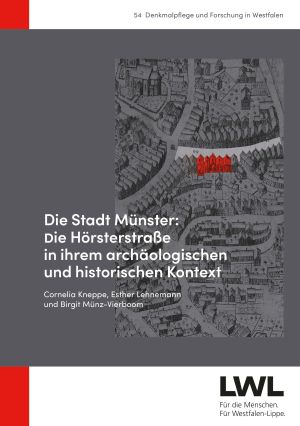
Die Stadt Münster: Die Hörsterstraße in ihrem archäologischen und historischen Kontext
Die Hörsterstraße in Münster ist seit dem 12. Jahrhundert Teil der Stadtgeschichte. Abseits der großen Bürgerhäuser tritt hier ein Wohnquartier in den Fokus der archäologischen und historischen Untersuchungen, in dem Menschen aller gesellschaftlichen Schichten lebten.
Einschneidende Ereignisse wie die Zerstörung im Siebenjährigen Krieg und der folgende Wiederaufbau lassen sich auch im archäologischen Befund nachvollziehen. Aus einem komplexen Baubefund und breit gefächertem Fundmaterial analysieren Cornelia Kneppe, Esther Lehnemann und Birgit Münz-Vierboom Aspekte der materiellen Alltagskultur in der Hörsterstraße 40–45 vom Mittelalter bis in die jüngste Vergangenheit.
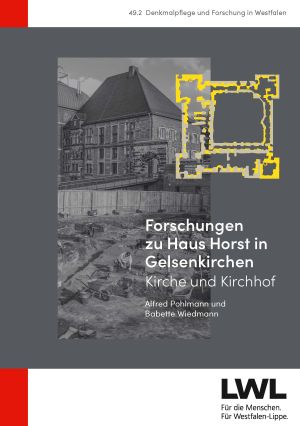
Forschungen zu Haus Horst in Gelsenkirchen: Kirche und Kirchhof
The second volume in the five-volume series on this unusual site focuses on the churchyard and the castle chapel, for which neither pictorial nor cartographic sources have survived. However, based on the results of the excavations, it has been possible to reconstruct its development from a wooden church in the 12th century to its demolition in 1753/1754. According to this findings, it stood in the middle of the outer bailey as a free-standing solitary building – a type of building that is just as rare in Westphalia as the patronage of St Hippolytus. A catalogue of all medieval castle churches, castle chapels and palace chapels in Westphalia provides material for a direct comparison.
The 460 individuals from more than 18 generations buried in the cemetery around the castle chapel were analysed from an anthropological perspective. The investigations, which are by no means commonplace in terms of their scope and completeness, conclude the volume.
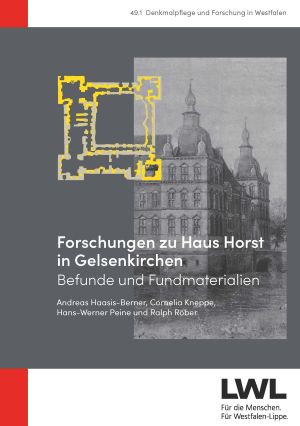
Forschungen zu HausHorst in Gelsenkirchen: Befunde und Fundmaterialien
Over the course of its several hundred years of history, the von der Horst family's residence in the Emscherbruch was subjected to numerous adversities, from changing ruling interests to repeated destruction by fire, each of which initiated a completely new beginning in architectural terms. Thanks to the archaeological investigations of this unusual site, there is a unique opportunity to trace the development from a 12th century farmstead to a motte and moated castle and finally to a Renaissance palace. The first volume of the five-volume series presents the features and finds.

Die Klosterkirche Corvey: Bauuntersuchung und Baugeschichte des Westbaus. Teil 2
As the oldest architectural monument in Westphalia-Lippe, the Carolingian west wing of the Church of St. Stephen and St. Vitus at the former Corvey Abbey is of outstanding importance for the historical identity of the region. The Benedictine Abbey of Corvey, built on the west bank of the Weser River, was one of the most important cultural and economic centres between the North Sea and southern Germany and engaged in lively intellectual and cultural exchange with other early medieval centres of learning in Europe. In this volume, Kristina Krüger has succeeded in producing a comprehensive documentation of the eventful architectural history of the west building, from its Carolingian beginnings in the 9th century through high medieval alterations to modern interventions and extensions.

Die Klosterkirche Corvey: Bauuntersuchung und Baugeschichte des Westbaus. Teil 1
As the oldest architectural monument in Westphalia-Lippe, the Carolingian west wing of the Church of St. Stephen and St. Vitus at the former Corvey Abbey is of outstanding importance for the historical identity of the region. The Benedictine Abbey of Corvey, built on the west bank of the Weser River, was one of the most important cultural and economic centres between the North Sea and southern Germany and engaged in lively intellectual and cultural exchange with other early medieval centres of learning in Europe. In this volume, Kristina Krüger has succeeded in producing a comprehensive documentation of the eventful architectural history of the west building, from its Carolingian beginnings in the 9th century through high medieval alterations to modern interventions and extensions.

Die Klosterkirche Corvey: Bauuntersuchung und Baugeschichte des Westbaus. Beilagen
As the oldest architectural monument in Westphalia-Lippe, the Carolingian west wing of the Church of St. Stephen and St. Vitus at the former Corvey Abbey is of outstanding importance for the historical identity of the region. The Benedictine Abbey of Corvey, built on the west bank of the Weser River, was one of the most important cultural and economic centres between the North Sea and southern Germany and engaged in lively intellectual and cultural exchange with other early medieval centres of learning in Europe. In this volume, Kristina Krüger has succeeded in producing a comprehensive documentation of the eventful architectural history of the west building, from its Carolingian beginnings in the 9th century through high medieval alterations to modern interventions and extensions.

Die Klosterkirche Corvey: Geschichte und Archäologie
The abbey church of the imperial monastery of Corvey in the Weser bend near Höxter looks back on more than 1,000 years of history. The westwork is the only completely preserved Carolingian building of its kind and is unique in Carolingian architecture. A renovation during the Romanesque period gave the west building its west facade, which is still preserved today and crowned by two slender Romanesque towers. Due to the unique, complex internal structure of the westwork and the quality of its furnishings, the ensemble was added to the UNESCO World Heritage List.
This volume presents the results of 40 years of archaeological research at the former Benedictine abbey of Corvey. Following an introduction to the history of the monastery, the features and finds are presented and the skeletal remains found in the church are analyzed from an anthropological perspective.