


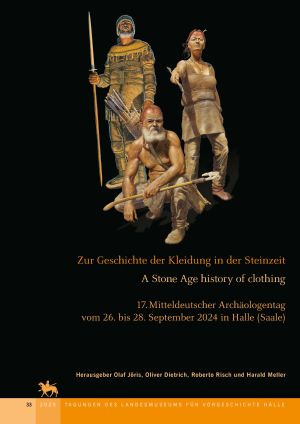
How to Cite

Jöris, Olaf et al. (Eds.): Zur Geschichte der Kleidung in der Steinzeit / A Stone Age History of Clothing: Mitteldeutscher Archäologentag vom 26. bis 28. September 2024 in Halle (Saale), Heidelberg: Propylaeum, 2026 (Tagungen des Landesmuseums für Vorgeschichte Halle, Volume 33). https://doi.org/10.11588/propylaeum.1678

Identifiers

ISBN 978-3-96929-468-0 (PDF)

Published

01/27/2026

Authors

Olaf Jöris (Ed.), Oliver Dietrich (Ed.), Roberto Risch (Ed.), Harald Meller (Ed.)

Zur Geschichte der Kleidung in der Steinzeit / A Stone Age History of Clothing

Mitteldeutscher Archäologentag vom 26. bis 28. September 2024 in Halle (Saale)

How did people dress in the Stone Ages, what materials and techniques did they use and how can they be traced? Is the beginning of clothing a result of an evolving sense of shame or just a practical protection against the elements? Closely linked is the investigation of human-animal relationships and what influence these had on the choice of raw materials for the production of jewellery and clothing.
This volume addresses these and other key questions in an interdisciplinary approach combining archaeology, natural sciences, cultural and media studies. To this end, the present studies examine direct evidence such as burials as well as indirect evidence from figurative depictions or tools in order to analyse the evolutionary and social significance of clothing.


Dr Olaf Jöris is deputy head of the Pleistocene and Early Holocene Archaeology competence area at the Leibniz Centre for Archaeology at the Archaeological Research Centre and Museum of Human Behavioural Evolution MONREPOS in Neuwied. He teaches Pre- and Protohistory at Johannes Gutenberg-Universität Mainz. His research is dedicated to the understanding of stone artefacts and spatial analyses as well as Palaeolithic art.

Dr Oliver Dietrich is a researcher at the State Office for Heritage Management and Archaeology Saxony-Anhalt and head of public relations. He was previously a research fellow in the Göbekli Tepe project of the German Archaeological Institute. His research focusses on the period from the Early Neolithic to the Late Bronze Age between Southwest Asia and Central Europe.

Prof. Dr Roberto Risch is professor of Prehistoric Archaeology at the Universitat Autònoma de Barcelona. He studied history, archaeology and anthropology at the universities of Freiburg, Barcelona and Cambridge. His research focusses on the economy and ecology of prehistoric societies in the Mediterranean and Central Europe from the Neolithic to the Copper and Iron Age.

Prof. Dr Harald Meller is a state archaeologist and director of the State Office for Heritage Management and Archaeology Saxony-Anhalt. He studied pre- and protohistory, archaeology of the Roman provinces and ethnology at the Ludwig-Maximilian-Universität München and Freie Universität Berlin. He teaches as an honorary professor at the Institute for Art History, Archaeology and Classical Studies at the Martin-Luther-Universität Halle-Wittenberg. His research focusses on the Early Bronze Age in Central Europe and the cultural history of European pre- and protohistory.

Chapters

Table of Contents
Pages
PDF
Titelei
Contents
Olaf Jöris, Oliver Dietrich, Harald Meller, Roberto Risch
9-26
Section I: From fiction to science and back to fiction – Clothing reconstructions and perceptions
Section II: Reasons why Humans Dress
Section III: Clothing as a Means of Protection and Well-being
Section IV: Materials and Methods in Clothing Production
Theresa Emmerich Kamper, Linda Hurcombe
151-158
159-169
Mario Mineo, Juan F. Gibaja, Gerard Remolins, Mauro Rottoli, Laura Caruso-Fermé, Vanessa Forte, Berta Morell, Izaro Quevedo-Semperena, Niccolò Mazzucco
213-223
María Borao Álvarez, Natacha Caurette, François-Xavier Chauvière, Romain Malgarini, Jean-Marc Pétillon
233-252
Susanne Friederich, Andrea Moser, Jonathan Schulz
Fallbeispiel Großgrimma, Burgenlandkreis
269-303
Martha Görlitz
The functionality of different types of whorls in practical use based on a case study of Feddersen Wierde, Cuxhaven District
305-315
Section V: Clothing and body ornamentation: Some examples
Shuqin Guo, Stefanie Kölbl, Marian Vanhaeren, Sibylle Wolf, Nicholas J. Conard
351-354
Martin Street, Elaine Turner
A new look at well-worn evidence from the sites Gönnersdorf and Andernach-Martinsberg (Germany)
355-364
Albert Hafner
Waterlogged finds from submerged and glacial sites
365-380
Section VI: Stone Age clothing and social differentiation as seen from burial contexts
Thorsten Uthmeier
A socioeconomic perspective on status and prestige during the Magdalenian and the Mesolithic
467-488
Section VII: Clothing and Body Ornamentation in Stone Age Artistic Contexts

Comments