


Forschungen zu Haus Horst in Gelsenkirchen
Haus Horst in Gelsenkirchen is one of the oldest and most significant Renaissance buildings in Westphalia.
Thanks to the archaeological investigations and extensive interdisciplinary research, the development of this unusual site can be described comprehensively and from many different angles. Volumes 1 and 2, containing the 'Features and Finds' and the 'Church and Churchyard' investigations respectively, are available not only in print, but also in open access here. The older volumes (Volume 3, 'The Medieval and Early Modern Ovens', published in 2009; Volume 4, 'Animal Bones from Eight Centuries', published in 2010; and Volume 5, 'Books of Account and Clay Pipes', published in 2014) are currently only available in print.
Series
Denkmalpflege und Forschung in Westfalen
- Volume: 49,1, 49,2
- Online ISSN: 2944-5833
- Print ISSN: 0175-2839
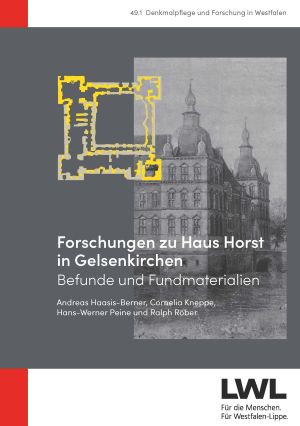
Forschungen zu HausHorst in Gelsenkirchen: Befunde und Fundmaterialien
Over the course of its several hundred years of history, the von der Horst family's residence in the Emscherbruch was subjected to numerous adversities, from changing ruling interests to repeated destruction by fire, each of which initiated a completely new beginning in architectural terms. Thanks to the archaeological investigations of this unusual site, there is a unique opportunity to trace the development from a 12th century farmstead to a motte and moated castle and finally to a Renaissance palace. The first volume of the five-volume series presents the features and finds.
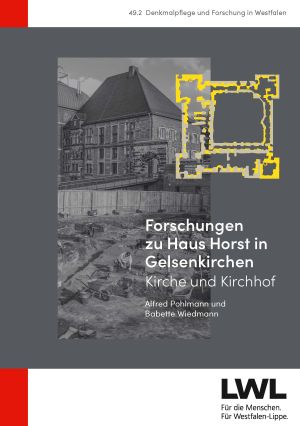
Forschungen zu Haus Horst in Gelsenkirchen: Kirche und Kirchhof
The second volume in the five-volume series on this unusual site focuses on the churchyard and the castle chapel, for which neither pictorial nor cartographic sources have survived. However, based on the results of the excavations, it has been possible to reconstruct its development from a wooden church in the 12th century to its demolition in 1753/1754. According to this findings, it stood in the middle of the outer bailey as a free-standing solitary building – a type of building that is just as rare in Westphalia as the patronage of St Hippolytus. A catalogue of all medieval castle churches, castle chapels and palace chapels in Westphalia provides material for a direct comparison.
The 460 individuals from more than 18 generations buried in the cemetery around the castle chapel were analysed from an anthropological perspective. The investigations, which are by no means commonplace in terms of their scope and completeness, conclude the volume.